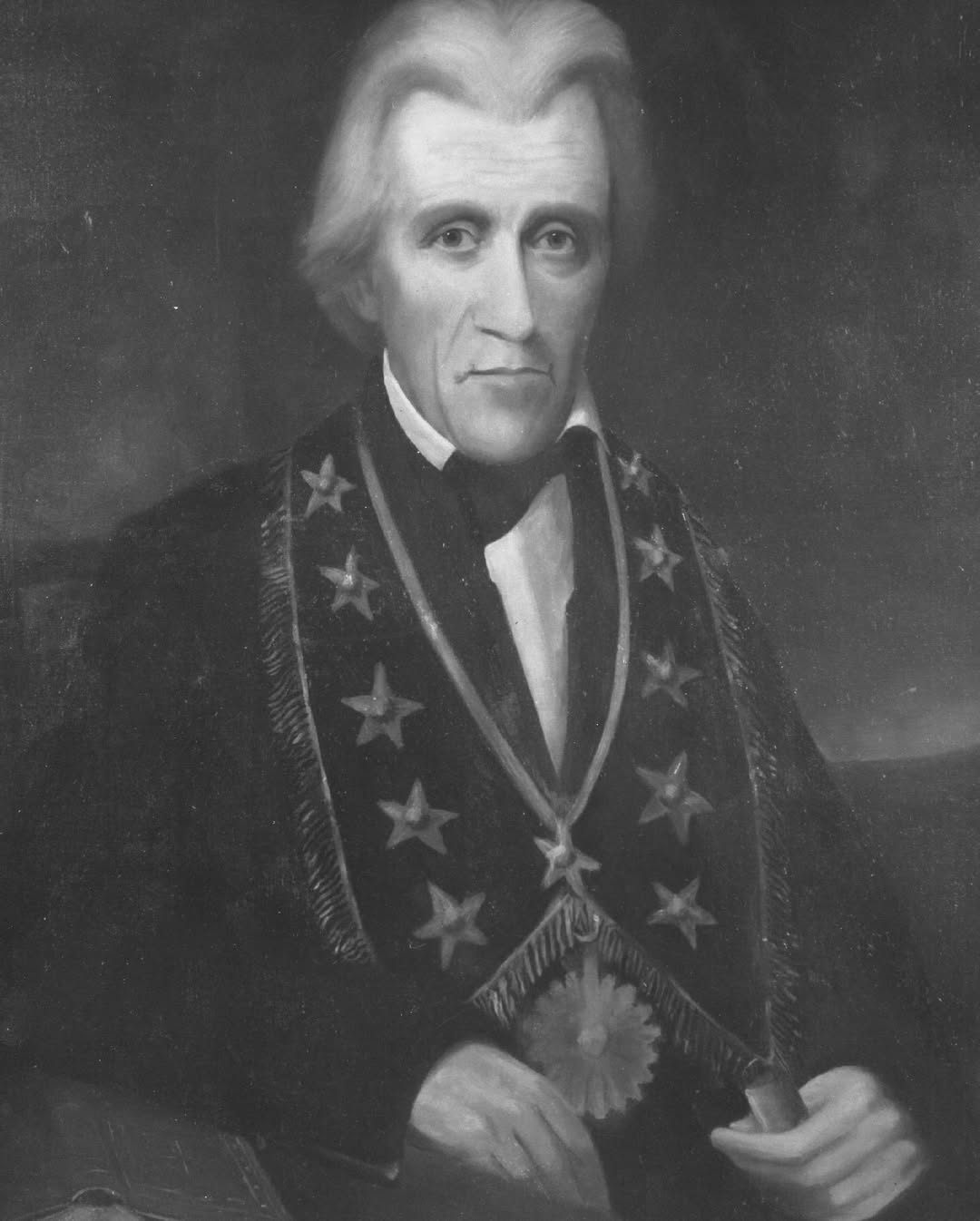
Of all the men whose lives passed under the gavel of the Grand Lodge of Tennessee, none has cast a longer shadow on the American Republic than Andrew Jackson. He was a frontier orphan, a tavern-brawler, a duellist, a general, and at last a President, and through the whole rough length of his life he was a Mason. He is one of two American Presidents to have served as Grand Master of a state Grand Lodge: Jackson in Tennessee, and Harry S. Truman a century later in Missouri.
Jackson came to the Carolina backcountry as a boy of thirteen during the Revolution, was captured by the British, and bore a sabre-scar across his face for the rest of his days. He read law in Salisbury, North Carolina, and crossed the mountains in 1788 to the young town of Nashville on the Cumberland. There he made his name as a prosecutor, a planter, and, soon enough, a soldier.
Initiation in the Craft
Jackson's first contact with Masonry is uncertain, but by the early 1800s he was a member of Harmony Lodge No. 1 in Nashville, the oldest still-working lodge in Tennessee. He was a man for whom the lodge's tenets, Brotherly Love, Relief, and Truth, were not abstractions but the rough furniture of the only fraternity he ever truly belonged to. He valued loyalty above almost any other virtue.
In 1815, Major General Jackson stunned the world at the Battle of New Orleans, routing a veteran British army with a force of regulars, frontier militia, free Black soldiers, and Lafitte's pirates. Word of the victory arrived in Washington at the same time as news of the Treaty of Ghent, and the young Republic at last felt itself, for the first time since 1776, truly safe. The hero was a Tennessee Mason.
Grand Master of Tennessee
Seven years later, on October 7, 1822, the Grand Lodge of Tennessee elected Major General Andrew Jackson as its Grand Master. He was re-elected the following year and served through October 1824, presiding over a fraternity then numbering some forty subordinate lodges scattered across a state still very much a frontier. His correspondence in the office was characteristically curt, precise, and uncompromising.
Jackson's Masonic career did not end with the gavel. He took a deep interest in the welfare of the Craft, defended it publicly during the Anti-Masonic agitation of the late 1820s and early 1830s, a period when many lodges in New York and New England closed under public pressure, and corresponded with brethren across the country. When the Anti-Masonic Party put forward William Wirt against him in the presidential election of 1832, Jackson's defense of the fraternity was characteristically unhesitating: he was, and would remain, a Mason.
The President in the Apron
Jackson's two terms in the White House (1829–1837) reshaped the office and the country. He destroyed the Second Bank of the United States, established the Democratic Party, faced down South Carolina's nullification, and, in the most painful chapter of his record, signed the Indian Removal Act of 1830. He is the most controversial figure on the American twenty-dollar bill, and historians still take his measure with great care.
What is not in dispute is the place he occupies in the Tennessee story. The Hermitage, his plantation east of Nashville, is today a museum visited by hundreds of thousands annually. His funeral in 1845 was conducted with full Masonic honors. The apron that lay across his coffin is among the most cherished artifacts of the Grand Lodge of Tennessee, and a reminder that the seventh President of the United States, before he was anything else to the nation, was a brother of the Craft.
Legacy in the Lodge
Three Tennessee counties, dozens of towns, a state university, and an entire era of American politics bear Jackson's mark. Within Freemasonry his memory is preserved most quietly and most enduringly: in the records of Harmony Lodge No. 1, in the oil portraits that line the walls of the Grand Lodge in Nashville, and in the simple title, engraved on every Tennessee Past Grand Master's jewel since, that he held in 1822 and 1824 and never set down.