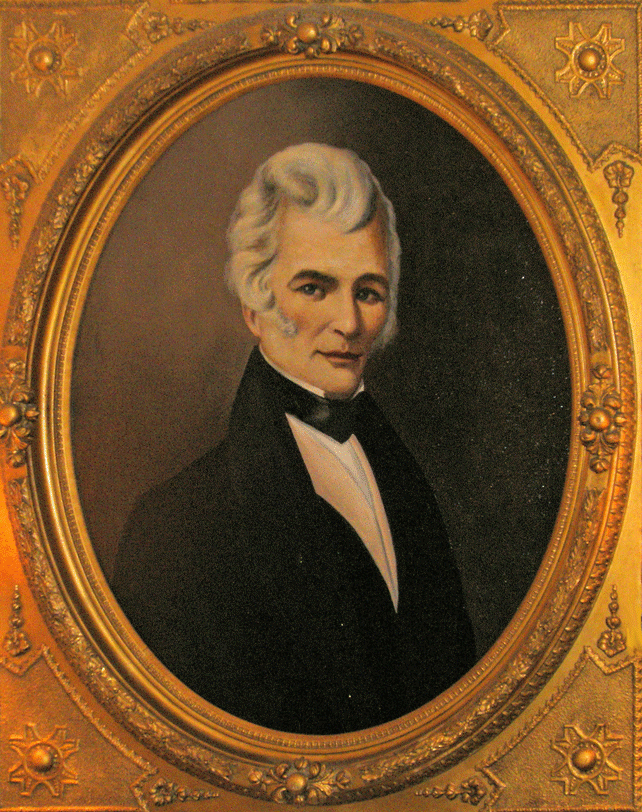
William Carroll served twelve years as Governor of Tennessee, three full terms before a constitutional gap, and three more after, making him by a comfortable margin the longest-serving chief magistrate the state has ever had. He was Andrew Jackson's right-hand man at the Battle of New Orleans, the modernizer who hauled Tennessee's laws and institutions out of their frontier infancy, and a man whose career was woven through the early Masonic generation of Tennessee.
From Pittsburgh to the Cumberland
Carroll was born in 1788 near Pittsburgh, Pennsylvania, the son of a Revolutionary War officer turned ironmaster. He arrived in Nashville in 1810 at the age of twenty-two, a young man of frontier-Pittsburgh manners, a sharp eye for business, and (in his own description) "no political ambitions whatsoever." He opened a hardware and nail-making establishment on the public square and within two years had become one of the more successful young merchants in the town.
He came to Andrew Jackson's notice almost at once. By 1812 he was a captain in the Tennessee militia. In the Creek War of 1813–14 he served as Jackson's brigade inspector and was wounded in action at Talladega. Jackson, who was a hard man to please, judged him "the bravest officer in my command, and the best executive head I have ever seen on a young man's shoulders."
Second-in-Command at New Orleans
Late in 1814, with the British invasion of the Gulf Coast imminent, Jackson ordered Major General Carroll to raise the Second Division of West Tennessee Militia and march south. Carroll did so, collecting muskets, lead, and powder by the wagonload as he descended the Cumberland and Mississippi, and reached New Orleans in early January 1815, just in time for the great battle.
Carroll commanded the center of the American line at the Battle of New Orleans on January 8, 1815. His Tennessee militia, sharpshooters firing from behind cotton-bale parapets, broke the British advance with one of the most devastating volleys in American military history. The British general Sir Edward Pakenham was killed; over two thousand of his men were killed, wounded, or captured; American losses were under one hundred. Jackson would later credit Carroll's division with the decisive role in the victory. Carroll returned to Nashville a hero.
Governor
Carroll was elected Governor of Tennessee in 1821, defeating the incumbent governor by an almost unprecedented margin, and was twice re-elected (1823, 1825). He stepped down in 1827, as the Tennessee constitution required, three consecutive terms being the limit, was succeeded by Sam Houston, and was returned to the office in 1829 after Houston's mysterious resignation. He served three more terms (1829, 1831, 1833) before stepping down for good in 1835. Twelve years in all.
His record was that of a careful and energetic modernizer. He pushed through reforms of the state penal code (Tennessee in his time abandoned a number of corporal punishments inherited from the colonial era and built its first state penitentiary at Nashville). He championed public education, internal improvements (turnpikes, river navigation), and the chartering of the new Bank of the State of Tennessee. He presided over the constitutional convention of 1834, which produced the second Tennessee constitution, a document that would govern the state for the next thirty-six years.
"He found Tennessee a frontier and left it a state."
Nashville Union, on Carroll's death, 1844
Among the Nashville Brethren
Carroll's Tennessee was inseparable from the Nashville Masonic community of the 1810s, '20s, and '30s, an unusually distinguished generation that included Andrew Jackson, Sam Houston, and many of the other shapers of the early state. Tennessee Masonic tradition has long counted Carroll among the brethren of that generation. The lodges of the time met in the upper rooms of taverns and courthouses, on the public square and elsewhere, in buildings long since gone but well documented in the early proceedings of the Grand Lodge.
Carroll's later years were difficult. He suffered from declining health (probably tuberculosis), saw his hardware business fail in the Panic of 1837, and was unable to win a final term as governor in 1837. He died in Nashville on March 22, 1844, at the age of fifty-six, and is buried in the city cemetery.
Carroll County, Tennessee, established in 1821, the year of his first inauguration, bears his name. So does the city of Carrollton in Carroll County. The portrait of him hanging today in the Tennessee State Capitol is a reminder of the longest tenure in the governor's chair the state has ever known, and of one of the most consequential brethren of the Cumberland lodges.