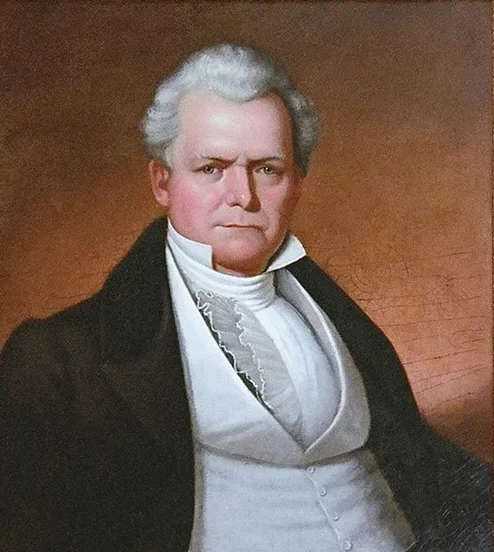
Felix Grundy was, in his own day, one of the most famous men in the United States. He was the leading criminal lawyer in the trans-Appalachian West; a War Hawk congressman whose speeches helped push the country into the War of 1812; the U.S. Senator who guided James K. Polk's early career; and at the very end of his life, Attorney General of the United States under Martin Van Buren. He was also, throughout that long career, a Tennessee Mason.
From Berkeley County to the Cumberland
Grundy was born in 1777 in Berkeley County, Virginia (now West Virginia), the eleventh of twelve children. His family removed to the Kentucky frontier when he was three, and he grew up amid the brutal Indian wars of the late eighteenth century, losing, by his own count, three of his elder brothers to those conflicts. He was educated at Bardstown, Kentucky, read law in Lexington, and was admitted to the Kentucky bar at nineteen.
He served in the Kentucky legislature, was elected a state circuit judge, and at thirty was named Chief Justice of the Kentucky Court of Appeals, the youngest man ever to hold that office. He resigned in 1808 (the salary, he complained, was inadequate to the dignity of the office) and removed to Nashville, Tennessee, where he set up a law practice that would soon make him one of the wealthiest men in the state.
The Greatest Criminal Lawyer in the West
Grundy's specialty was criminal defense, and his record was extraordinary. He is reliably reported to have defended 165 men charged with capital crimes in the course of his career, and to have lost only one to the gallows. He was a master of the cross-examination, a tireless researcher of authority, and, above all, a courtroom orator of the old school, capable of holding a packed courthouse spellbound for hours at a stretch.
His mentorship of younger Tennessee lawyers was legendary. James K. Polk read law in his Nashville office in the years 1818–1820 and was admitted to the bar under Grundy's recommendation. Polk would later say that he owed his political career to his old preceptor, and would remember him as the greatest natural advocate he had ever known.
The Mason
Grundy was a member of Hiram Lodge No. 7 in Franklin, Tennessee, one of the eight lodges represented at the constituting of the Grand Lodge of Tennessee in 1813, and was a frequent visitor to the Nashville lodges where his political life was carried on. He served in offices of trust in the Craft, was a respected figure in the proceedings of the Grand Lodge of Tennessee, and was the friend and contemporary of Andrew Jackson, Sam Houston, and the other great Masonic figures of his Tennessee generation.
The War Hawk
Grundy was elected to the United States House of Representatives in 1810 and served two terms. He arrived in Washington at the moment of the great American crisis with Britain, and quickly emerged as one of the leaders of the so-called War Hawk faction, alongside Henry Clay of Kentucky and John C. Calhoun of South Carolina, who pushed the Madison administration to declare war in June 1812. His speeches on the floor of the House, particularly that of December 9, 1811, were widely reprinted and helped move public opinion toward war.
Senator and Attorney General
Grundy returned to Tennessee at the end of the war and devoted the next fifteen years to the practice of law and the rebuilding of his family fortune. In 1829 the Tennessee legislature elected him to the United States Senate, and he served from 1829 to 1838. He was a faithful supporter of his old friend Andrew Jackson, particularly through the bitter Bank War of the 1830s, and one of the most respected debaters in the upper house.
In 1838 President Martin Van Buren appointed Grundy Attorney General of the United States. He held the office for a little over a year, returned to the Senate in 1839, and died in Nashville in December 1840 at the age of sixty-three.
"He was an orator of the first rank, and an advocate at the bar without a superior in any court in which he ever appeared."
Memorial in the Nashville Republican Banner, 1840
Grundy County, Tennessee, was named for him in 1844. His Nashville home, purchased and enlarged in the 1820s, was inherited by his son-in-law, James K. Polk's brother-in-law, and was eventually purchased by Polk himself as the President's retirement house, Polk Place. Two great Tennessee Masons, two great American careers, one Nashville address.