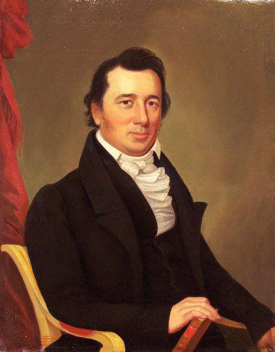
Of the thirty-nine men whose signatures stand at the foot of the United States Constitution, only one carried that document over the Appalachian wall to plant it in the West. He was William Blount of North Carolina, soon to be of Tennessee, Constitutional Framer, Territorial Governor, U.S. Senator, and Freemason.
The Eastern Statesman
Blount was born in 1749 in Bertie County, North Carolina, the eldest son of a wealthy planting family with deep colonial roots. He served as a paymaster in the North Carolina militia during the Revolution, then settled into a long career in the state's legislature and in the Continental Congress. By 1787 he was, at thirty-eight, one of North Carolina's three delegates to the Federal Convention in Philadelphia.
He was not, by his own admission, a frequent speaker on the convention floor, he kept silent through most of the proceedings, but on September 17, 1787, he stepped forward with the rest and signed the new Constitution of the United States. His signature is among the surest documentary anchors of his life, and it placed him forever among that small company of men remembered as the Founding Fathers.
Governor of the Southwest
In 1790 the new federal government created the Territory South of the River Ohio, better known as the Southwest Territory, out of lands ceded by North Carolina. President George Washington appointed William Blount its governor. Blount established his territorial capital first at Rocky Mount (today's Piney Flats, Tennessee) and then at the new town of Knoxville, named in honor of Secretary of War Henry Knox. The handsome frame house he built there in 1792, the Blount Mansion, is the oldest surviving frame house west of the Appalachians and is preserved today as a National Historic Landmark.
For six years Blount governed the territory: surveying boundaries, treating with the Cherokee, establishing courts, and corresponding constantly with President Washington. In 1796 he convened a constitutional convention at Knoxville, presided over the writing of the Tennessee state constitution, and shepherded the new state's petition for admission through the Congress. On June 1, 1796, Tennessee was admitted to the Union as the sixteenth state.
A Founder Among Brethren
The earliest Masonic charters in what would become Tennessee, including St. Tammany Lodge in Nashville (organized 1789) and Tennessee Lodge No. 2 at Knoxville (chartered 1800), arose during Blount's territorial governorship. Tennessee Masonic tradition has long counted him among the friends of the Craft on the frontier, and many of his closest political allies, John Sevier among them, were members of the early Tennessee lodges.
The men who framed the Tennessee constitution at Knoxville in 1796 included a striking proportion of brethren of the Craft, and the principles of the new state government were shot through with the language of Enlightenment, religious toleration, and natural rights that the lodges of the eighteenth century had so often made their own.
The First U.S. Senator from Tennessee
The Tennessee legislature elected Blount and William Cocke as the new state's first two United States Senators. Blount took his seat in the Senate at Philadelphia in late 1796.
His Senate career, however, ended in scandal. In 1797 a private letter of his, referencing a complicated and probably half-baked plan to assist the British in seizing Spanish Louisiana and Florida from Spain, fell into President Adams's hands. Blount was expelled from the Senate by a vote of 25 to 1, the first official ever expelled from that body, and an attempted impeachment was dismissed on jurisdictional grounds.
The voters of Tennessee took a different view. The state legislature elected him to its own state senate the very next year, and chose him as its speaker. He died of a fever at his Knoxville home on March 21, 1800.
"Tennessee owes more to William Blount than perhaps to any other man of his generation."
John H. DeWitt, The First American Frontier
His grave is in the First Presbyterian Church cemetery in Knoxville. Blount County, Tennessee, and the city of Maryville within it, bear his name. So does the federal courthouse on the Knoxville square. He was the first Tennessean to put his hand to the Constitution of the United States, and the man who, more than any other, made Tennessee a part of the Union under that Constitution.