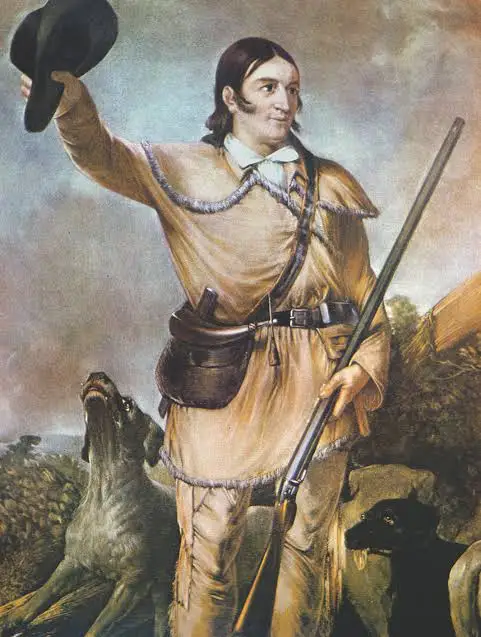
If Andrew Jackson is Tennessee's most consequential Mason, David Crockett is its most beloved. The image of him in coonskin cap and fringed hunting shirt, squinting down a long rifle at a Tennessee bear, has been with American children for almost two hundred years now. Behind that image stands a man more interesting and more honest than the legend: a self-made backwoodsman, a sometimes-bitter politician, a faithful husband, a sympathetic neighbor, and, by tradition long held in Tennessee, a Freemason.
The Boy on Limestone Creek
Crockett was born on August 17, 1786, in a log cabin on Limestone Creek in present-day Greene County, in the same upper East Tennessee country where John Sevier had raised the State of Franklin and Tennessee Lodge No. 41 had taken its first charter. He was the fifth of nine children. His father was a tavern-keeper who, by Crockett's own description, "was so frequently embarrassed in his circumstances that I could get but little learning."
He bound himself out as a teamster at the age of twelve, ran away, returned, hired out as a laborer to pay his father's debts, and finally, at the age of sixteen, was sent to school for four days a week. He stayed six months. That was the entirety of his formal education.
The Frontiersman in Politics
Crockett married Polly Finley in 1806, settled briefly in Lincoln County, then pushed west into Franklin and finally into Lawrence County. He served as a scout under Andrew Jackson in the Creek War of 1813–14, though he and Jackson would later become bitter political enemies. By 1821 he was in the Tennessee state legislature; by 1827 he was in the United States House of Representatives, representing the cane-brakes and bayous of West Tennessee.
In Washington he was, at first, a curiosity, the backwoodsman with the homespun manner and the gift of plain speech. But his independence proved more durable than his novelty. He broke with President Jackson over the Indian Removal Act of 1830, one of the very few Southern congressmen to vote against it, declaring on the floor of the House that he could not, in conscience, support a bill that would force the Cherokee from their lands. The vote ended his political career. Tennessee Democrats turned him out at the next election.
"I would rather be politically buried than to be hypocritically immortalized."
David Crockett, on the Indian Removal Act
"You Can All Go to Hell, and I Will Go to Texas"
So he reportedly told a meeting of his Tennessee constituents in November 1835, after his final defeat. He was as good as his word. By January 1836 he was in Nacogdoches, Texas, taking the oath as a volunteer in the Texas army. By February he was in San Antonio de Béxar with William Barret Travis and James Bowie, fortifying an old Spanish mission called the Alamo against the advancing army of Santa Anna.
The Alamo fell on March 6, 1836. Every defender within its walls was killed. Crockett was among them. He was forty-nine years old. The exact circumstances of his death have been the subject of two centuries of contention; what is not in dispute is that he was there to the end, and that the loss of him was felt across the country as the loss of a folk hero.
The Question of His Masonry
Crockett's Masonic affiliation is a matter of long Tennessee tradition rather than documentary record. No surviving lodge minutes place him as an initiated member of any specific Tennessee lodge, and the often-repeated story of an apron supposedly given to a Texas brother on the eve of the Alamo has been traced by Masonic scholars to a single late-nineteenth-century letter whose chain of custody cannot be independently verified. The tradition is venerable; the evidence is thin. Both deserve to be set down honestly.
What is beyond doubt is that Crockett's Tennessee, the Tennessee of frontier lodges and traveling brethren, was the cradle of his character: the plain dealing, the loyalty to friends, the inability to dissemble, the readiness to suffer for a cause he believed right. These are the marks the Craft has always tried to lay upon its members. They were the marks of David Crockett.
The Crockett Tavern Museum in Morristown, Tennessee, preserves the home of his boyhood. The Alamo, in San Antonio, preserves the place of his death. Between the two stands a life that, in the great American imagination, has come to mean honesty, courage, and the willingness to be politically buried rather than hypocritically immortalized.