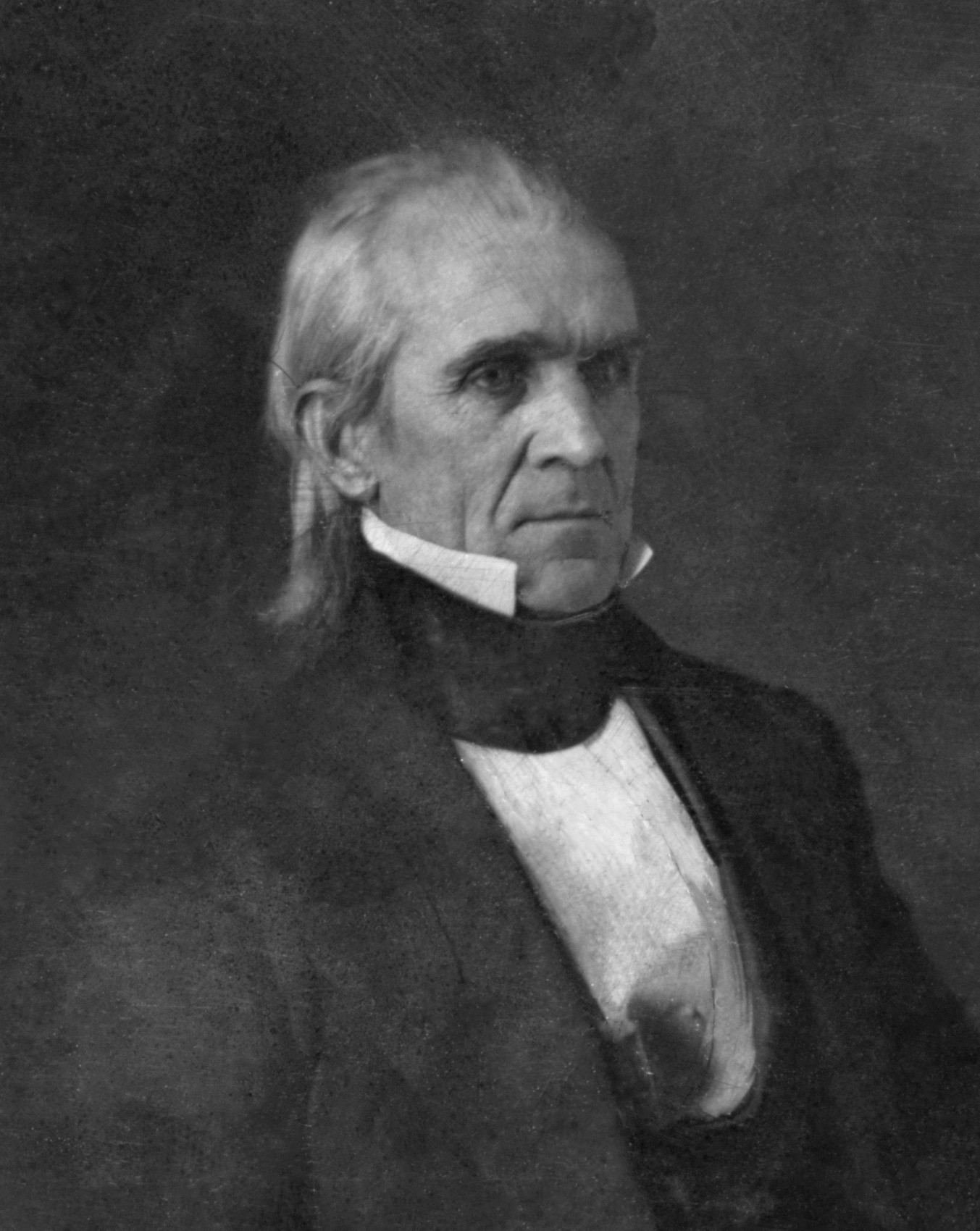
James K. Polk was, by the testimony of nearly every historian who has examined his single term, the most consequential one-term President in American history. In four years (1845–1849) he annexed Texas, settled the Oregon boundary with Britain, prosecuted and won the Mexican–American War, and acquired California, New Mexico, and the entire American Southwest. He kept his promise to leave office after one term, and died less than four months after walking out of the White House. He was a Tennessean and a Mason.
From Mecklenburg to Maury County
Polk was born in 1795 in Mecklenburg County, North Carolina, the eldest of ten children of a prosperous farming family. In 1806 his parents loaded the children into wagons and crossed the mountains to settle in the Duck River valley of Maury County, Tennessee, at that time the deep frontier of American settlement. He was a sickly boy whose ill health would shadow him for the rest of his short life, but he was also a brilliant student, graduating with honors from the University of North Carolina in 1818.
He read law in Nashville under Felix Grundy, the most celebrated criminal lawyer of the early Republic and a Tennessee Mason, and was admitted to the bar in 1820. He set up practice in Columbia, Tennessee, the seat of Maury County. Within four years he was in the state legislature; within five he was in the U.S. House of Representatives.
Raised at Columbia Lodge
On June 5, 1820, James K. Polk was initiated an Entered Apprentice in Columbia Lodge No. 31, in the Tennessee town that would be his lifelong home. He was passed and raised over the following months. The lodge was newly chartered, and Polk, a quiet, methodical, exceedingly disciplined young man, was among its most attentive early members. Throughout his political career he kept his Masonic dues in good standing and corresponded with the lodge.
The Speaker, the Governor, the President
Polk's political mentor was Andrew Jackson, who took the young Tennessean under his wing and lent him the nickname Young Hickory. He served fourteen years in the House of Representatives, four of them (1835–1839) as Speaker, a tenure marked by his iron control of an unruly chamber. He left Washington to win a single term as Governor of Tennessee (1839–1841), then lost the office twice in succession.
His political career appeared to be over. In 1844 the Democratic National Convention deadlocked between Martin Van Buren and Lewis Cass. On the ninth ballot, Polk's name was put forward as a compromise; on the ninth he was nominated. He was the first dark-horse candidate in American history. His Whig opponent, Henry Clay, dismissed him with the contemptuous question: "Who is James K. Polk?"
The country answered in November. Polk won.
A Continental Republic
Polk took the oath of office in March 1845 having stated four objectives: the annexation of Texas, the settlement of the Oregon question, the acquisition of California, and a substantial reduction in the tariff. He achieved all four. Texas was annexed within months. The Oregon boundary was fixed at the 49th parallel by treaty with Britain in 1846. War with Mexico, declared in May 1846, concluded in February 1848 with the Treaty of Guadalupe Hidalgo, which transferred to the United States more than half a million square miles of territory: present-day California, Nevada, Utah, most of Arizona and New Mexico, and parts of Colorado and Wyoming.
Polk worked himself to the bone. He was, by reliable accounts, the first president to keep no extended vacation, no appreciable rest, and almost no social life apart from his beloved wife Sarah. He left Washington in March 1849 a visibly broken man.
"I prefer to supervise the whole operations of the Government myself, rather than entrust the public business to subordinates, and this makes my duties very great."
James K. Polk, diary entry
Polk Place
He returned with Sarah to Nashville and to a fine home, Polk Place, where he had hoped to spend a long retirement. He contracted cholera on the journey and died on June 15, 1849, the shortest retirement of any American president. He was fifty-three.
He is buried today on the grounds of the Tennessee State Capitol in Nashville. His Masonic memberships are recorded in the proceedings of the Grand Lodge of Tennessee. Of all the brethren that the Volunteer State has sent into the Executive Mansion, none has accomplished more in less time, and none has gone home so quickly to rest.