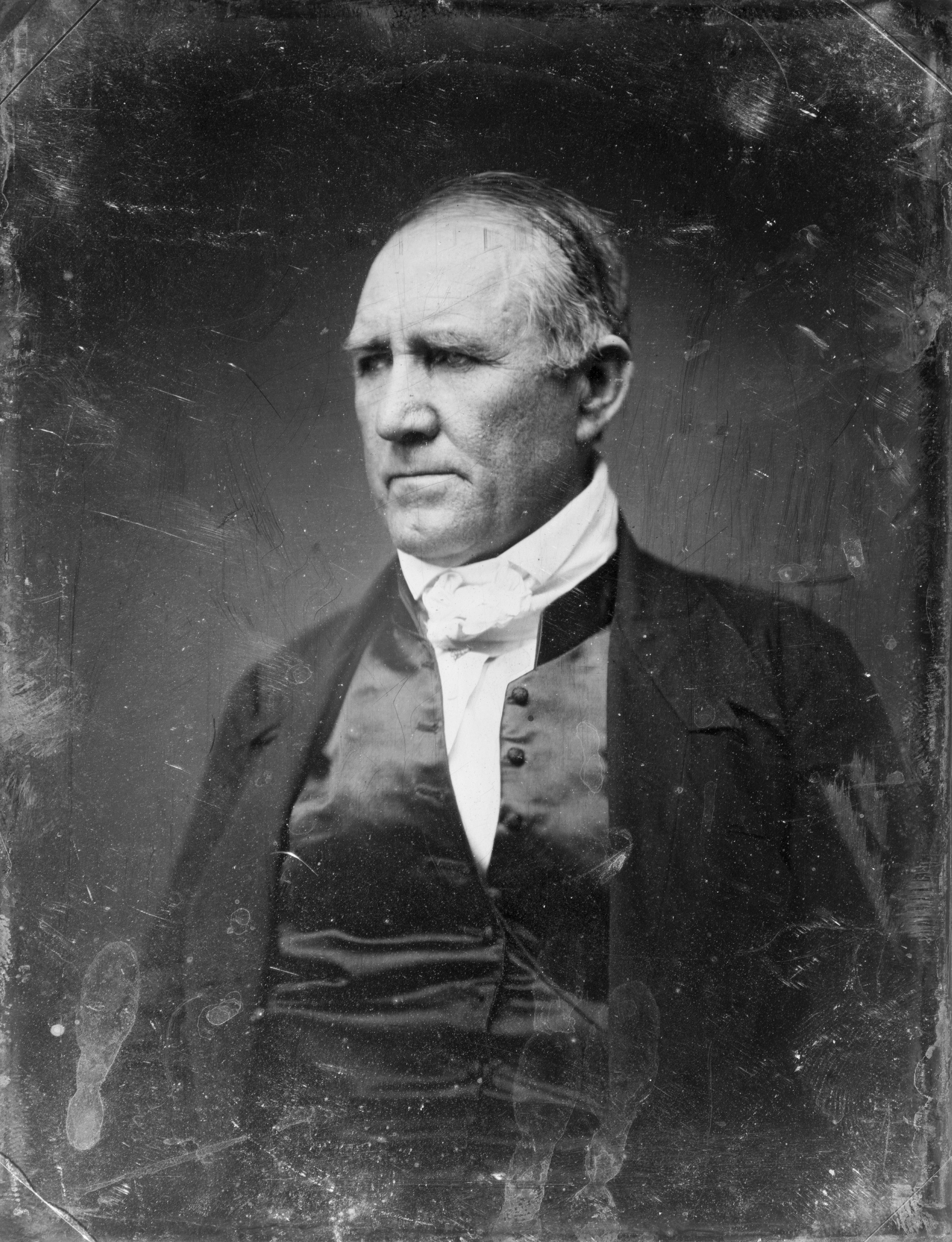
The life of Sam Houston is the wildest improbability the American nineteenth century has to offer. Born in Virginia, raised among the Cherokee in East Tennessee, wounded three times under Andrew Jackson at the Battle of Horseshoe Bend, governor of Tennessee at thirty-four, exile and adopted son of the Cherokee Nation by thirty-six, commander-in-chief of the Texas army at forty-three, twice president of the Republic of Texas, twice U.S. Senator, governor of Texas, and at the end of it all, deposed from that last office for refusing to swear an oath of loyalty to the Confederacy. Through every chapter of that life, Sam Houston was a Master Mason.
The Tennessee Years
Houston came to Maryville, Tennessee, with his widowed mother and eight siblings in 1807. By his own account he was an indifferent student. Sometime around the age of sixteen he ran away across the Tennessee River and lived for nearly three years among the Cherokee on Hiwassee Island, taking the name Colonneh, "the Raven", and becoming an adopted son of Chief John Jolly. The experience marked him for the rest of his life.
The War of 1812 made him a soldier. As a young ensign under Andrew Jackson at the Battle of Horseshoe Bend in March 1814 he was struck by a Creek arrow in the thigh and twice by musket-balls in the shoulder. He survived only with great difficulty, and Jackson, who had taken a personal interest in the young man, became his lifelong patron and political mentor.
Raised in Nashville
On the night of April 19, 1817, in the upper room of a Nashville building, Sam Houston was initiated an Entered Apprentice in Cumberland Lodge No. 8. He was passed to the degree of Fellowcraft on June 20, and raised a Master Mason on July 22, 1817. He was twenty-four years old. The lodge minutes still survive. He would later affiliate with lodges in Texas and serve in offices of trust in the Craft for the rest of his life. The Masonic apron made for him in Texas, embroidered with the Lone Star, is today preserved as one of the great relics of American Freemasonry.
Houston's rise in Tennessee politics was meteoric. By 1823 he was in the U.S. House of Representatives. By 1827, at the age of thirty-four, he was Governor of Tennessee, Andrew Jackson's chosen heir apparent in the state. And then, in April 1829, just two years into his term and three months after a brief and mysterious marriage, he resigned the governorship without explanation, left the state, and returned to live among the Cherokee in what is now Oklahoma. The reasons he kept to himself for the rest of his days.
San Jacinto
By 1832 he had drifted south into Texas, then a province of Mexico, increasingly settled by Anglo-Americans. When the Texas Revolution broke out in 1835, Houston was named major general of the Texas army. On April 21, 1836, on a marshy plain near present-day La Porte, Texas, he led 900 men in a surprise attack on the Mexican army of Antonio López de Santa Anna. The Battle of San Jacinto lasted eighteen minutes. Texas was free.
Houston was elected the first president of the Republic of Texas, served a second non-consecutive term, and after annexation in 1845 became one of the new State of Texas's first U.S. Senators, serving thirteen years in the upper house. In 1859 he was elected Governor of Texas, the only American ever to have governed two different states. (Tennessee, as he often pointed out, was the first.)
The Last Stand
His final battle was political. When Texas voted to secede from the Union in 1861, Governor Sam Houston refused to take the oath of loyalty to the Confederacy. He was deposed from office. He retired to Huntsville, Texas, where he died in July 1863, a Mason, a Unionist, and an old man who had lived more lives than most nations.
"I would lay down my life to maintain the Union, and prevent dissolution… but I have refused, and will never take, an oath of allegiance to any other government."
Sam Houston, March 1861
He is buried in Huntsville beneath a monument inscribed with words borrowed from his old commander Andrew Jackson: "The world will take care of Houston's fame."