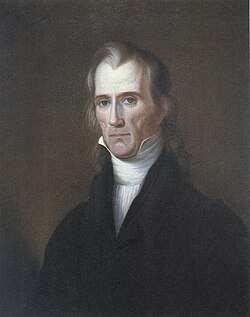
Hugh Lawson White is one of the great forgotten figures of antebellum Tennessee. In his own time he was widely respected as the most incorruptible man in the United States Senate; in 1836 he was put forward as a Whig candidate for the presidency and carried Tennessee against his old friend Andrew Jackson's chosen successor; and yet today he is remembered chiefly by the Tennessee county that bears his name. He was a lawyer, a jurist, a senator, and a Freemason.
From Iredell County to Knoxville
White was born in 1773 in Iredell County, North Carolina, the son of General James White, the founder of Knoxville. The family crossed the mountains to settle on the Holston River in 1786, when Hugh was thirteen. The boy received what frontier schooling could be had in those years, an exceptional education by Tennessee standards, and at sixteen rode east to Philadelphia to study mathematics and natural philosophy with the Reverend Samuel Stanhope Smith.
Returning to Tennessee in his early twenties, White read law in the offices of Archibald Roane (later governor of Tennessee) and was admitted to the bar of the Southwest Territory. He served briefly in militia campaigns against the Cherokee and was, at the age of twenty-eight, elected a judge of the Tennessee Superior Court of Errors and Appeals, the predecessor of the present Tennessee Supreme Court. He sat on that bench for six years.
Banker, Senator, "Cato"
In 1812 White was named president of the Bank of the State of Tennessee at Knoxville, a position he held for fifteen years and through which he steered the bank, almost alone among Tennessee institutions, through the Panic of 1819 with its solvency intact. The episode made his reputation for prudence and integrity beyond Tennessee.
In 1825 the legislature elected him to fill the United States Senate seat vacated by Andrew Jackson, who had resigned to focus on his second presidential campaign. White served in the Senate for fifteen years (1825–1840) and was twice chosen as President pro tempore of that body. His colleagues called him the Cato of the Senate for his austere manners and his unwillingness to traffic in patronage. He was, by every contemporary account, painfully honest.
A Public Man of His Generation
The civic culture of Knoxville in the 1820s and 1830s, in which White moved as banker, judge, and senator, was inseparable from the early Tennessee Masonic lodges. Many of his closest professional associates, the Cocke and Roane families among them, were brethren of those lodges, and the atmosphere in which White's reputation for austerity and incorruptibility was formed was the same atmosphere that the Craft, with its long discipline of patient deliberation, helped shape.
White was a representative figure of that generation: a public man whose private convictions, religious, civic, and fraternal alike, were formed by the long, deliberative habits of frontier Tennessee at its best.
The Election of 1836
White had been one of Andrew Jackson's closest friends and political allies for thirty years. The break, when it came, was painful. By the early 1830s White had grown alarmed at what he regarded as Jackson's expansion of executive power, particularly in the Bank War and the spoils system, and at the maneuvering by which Jackson was attempting to install Martin Van Buren of New York as his successor. In 1835 a coalition of Tennessee, Alabama, and other Southern Whigs put White's name forward as their candidate for the presidency in 1836.
He ran a quiet campaign, refused to make a single public speech in his own behalf, and lost, but he carried Tennessee against Van Buren by some twenty thousand votes. It was the first time the state had voted against a candidate endorsed by Andrew Jackson, and it was the first warning of the political realignment that would eventually carry the Whig Party to the presidency in 1840.
"He never sought office, and he never would consent to be a candidate without giving the people his real opinions on every great public question."
Memorial address in the U.S. Senate, 1840
Resignation and Death
White's last act in the Senate was a resignation. In 1840 the Tennessee legislature, then under Democratic control, instructed its senators to vote for the sub-treasury bill, an administration measure White opposed in principle. Rather than disobey the legislature or vote against his conscience, he resigned his seat and went home to Knoxville. He died there in April of that year.
White County, Tennessee, created in 1806, and the town of White House in Robertson County both honor his name (or that of his father). He is buried in Knoxville. The Grand Lodge of Tennessee preserves his memory as one of the most upright public men ever produced by the Craft in this state.